
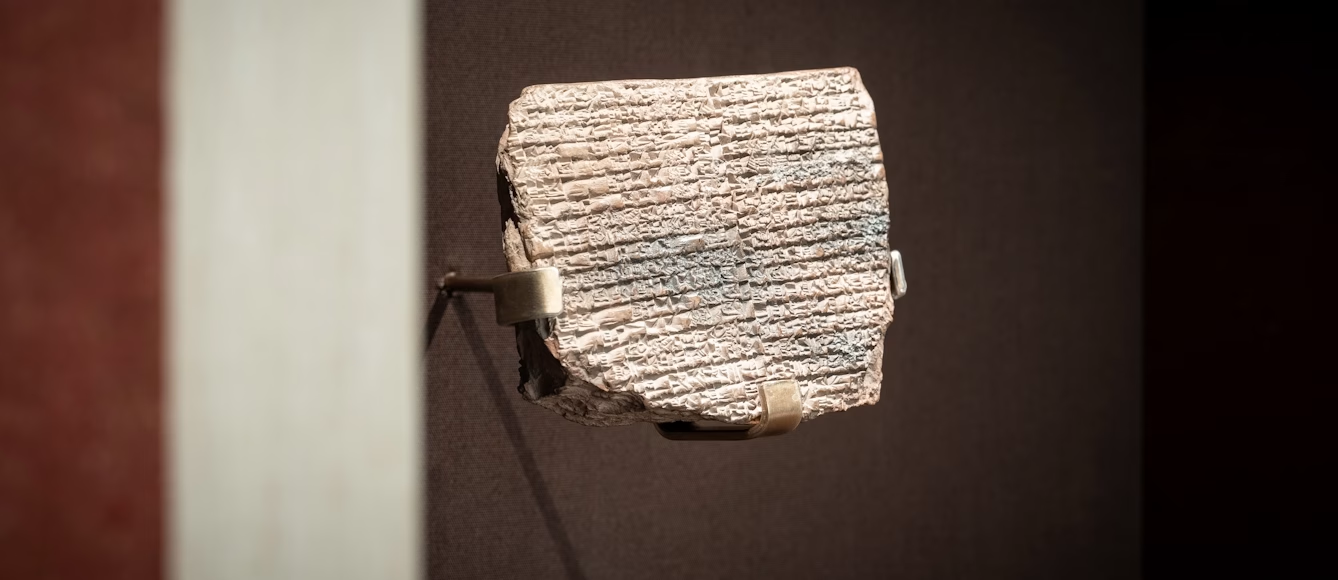

In February the Imaging Team at the John Rylands Library received an interesting request: Cuneiform 931 (a literary tablet from the Old Babylonian period on the conquest of Kish under Agga, by Gilgamesh, in Sumerian) was going on exhibition loan to the Wellcome Collection in London, and would we be able to make a facsimile, as a handling item, for the visiting public?
We already had photogrammetry data of this cuneiform on Sketchfab, but we also had 3D data captured using an Artec Spider portable scanner. This was therefore the perfect opportunity for us to compare various 3D printing methods. Although we do not have 3D printing capabilities within the Library, we are very keen to collaborate with colleagues and other departments within the University and further afield.
We first visited the B.15 Modelmaking Workshop, part of the Manchester School of Architecture. We have worked with this team before, and they had just taken delivery of a Fuse+30W SLS powder printer.
First version: Selective Laser Sintering
SLS (Selective Laser Sintering) nylon printers work by selectively fusing powdered nylon material with a laser to build 3D objects layer by layer. The process involves spreading a thin layer of nylon powder, then using a laser to trace the cross-section of the object, fusing the powder where the laser hits. This process is repeated, with the build platform lowering and a new layer of powder being spread, until the object is complete. The final printed model then needs to be excavated from the non fused powder, which can be reused.
Thanks to Paulina Voang for her assistance.

We thought the weight and detail were fairly accurate to the original (Figure 1), but felt the layer lines/contours were too visible in this example. A different orientation may resolve this in future reprints. There is also a slight granular surface texture.

PrintCity at MMU have been very helpful in the past, and we have witnessed their impressive lab grow over the past 10 years or so. They printed our marvellous Rylands statues as seen in this previous blog post.
PrintCity recommended we use one of their SLA printers for the resin print. Here you can see a test print with its supports (Figure 3.

Second version: Stereolithography
Stereolithography (SLA) is a 3D printing process that uses Ultraviolet (UV) lasers to draw out each layer of the model into a vat of photopolymer liquid resin. The photopolymers are sensitive to UV light and solidify into a rigid polymer at the points where the laser meets it. The process is repeated for each layer of the model.
Thank you Gary Buller for your assistance and advice.


Results included a much smoother finish with similar detail and weight to the nylon powder print, although this 3D print had noticeable lines throughout the print, which in places were quite deep.
Our third option – and the cheapest of the three – was to use PLA printing with my recently purchased Bambu A1 3D printer.
Third version: Polylactic Acid
Polylactic Acid (PLA) is a very popular and accessible 3D printing method. It uses thermoplastic filament derived from renewable resources like cornstarch or sugarcane. The PLA filament is heated to its melting point (around 180–220°C), then extruded layer by layer to build a 3D object.

Initial results were very promising, and although layer lines were visible, they were much less obvious that the powder and resin prints. The downside of printing in this medium, however, is that it is lightweight and lacks the material weight when held in hand and compared to the original cuneiform.

The lack of weight was resolved by hollowing out the 3D data model, then printing with this new cavity and filling it with sand through a small aperture in the base, before finally sealing it with a suitable filler (in this case wood filler).

The final filled and sealed model can then be primed and coloured with several layers of acrylic paint. I’m not very skilled with a paintbrush, but I had a good go. Although I do have to thank Lee McStein for some very helpful tips.

Below are three variations, and what we felt was the best representation of the original was sent to the Wellcome Collection. Interestingly, their conservation team were able to use this model to make an accurate display mount for the original cuneiform when it arrived on loan.


The addition of the tiny paper sticker is a nice finishing touch but even in the three versions shown above you can see the variations in painted quality.
To be fair, nearly all 3D printed objects need some final manual processing, whether that be sanding, filling, priming or painting. We just had a little more control over the final PLA printed versions.
Thirst: In Search of Freshwater exhibition
Last week I was able visit the exhibition and see the original and the facsimile in situ side by side. It is the opening item of the Thirst: In Search of Freshwater exhibition, and it is on display until 1st February 2026.


As written on the Wellcome Collection’s website about the exhibition:
“Thirst is a universal human experience shared with most living beings. With only 3% of the water on Earth being freshwater, our land thirsts too. ‘Thirst: In Search of Freshwater’ explores humanity’s vital connection with freshwater as an essential source of life and pillar of good health.
From ancient Mesopotamia and Victorian London to modern-day Nepal and Singapore, the exhibition highlights the vital role of freshwater in shaping health and ecosystems; the consequences of mismanagement, like the spread of infectious disease; and community-led solutions to the global water crisis.
‘Thirst’ features 125 objects, including historical artefacts, contemporary materials and artworks from Gideon Mendel, Chloe Dewe Mathews, Susan Schuppli, Anthony Acciavatti, Dala Nasser, Adib Dada, M’hammed Kilito, and Adam Rouhana, amongst others. Through new commissions by Raqs Media Collective, Karan Shrestha and Feifei Zhou and Zahirah Suhaimi (SEACoast), we invite you on an immersive journey to uncover our relationship with water.
The exhibition is curated by Janice Li and accompanied by the book Thirst: In Search of Freshwater, featuring leading writers Robert Macfarlane, Elif Shafak and Lucy Jones.”


Lastly, a big thank you to Adam Rose, Assistant Curator at Wellcome Collections for sparing some time to speak to me about how well the cuneiform and the facsimile have been received by visitors.
We will be blog posting about more 3D-printed collection items in the coming months, including on experimental printing from data using our Selene photometric stereo system.
All images unless otherwise stated are copyright of the University of Manchester and can be used under the Creative Commons Attribution-Non-Commercial-Share Alike Licence.
Ooooh! Hope this comes out to play at some of your Rare Reads!
Congratulations on a fascinating exploration of the different methods of 3D printing, Tony. Burying sand within the tablet, so to speak, is a neat inversion of the history of cuneiform tablets, most which were buried in the sands of Iraq and elsewhere. The comparative sustainability of PLA is a strong argument in its favour.