

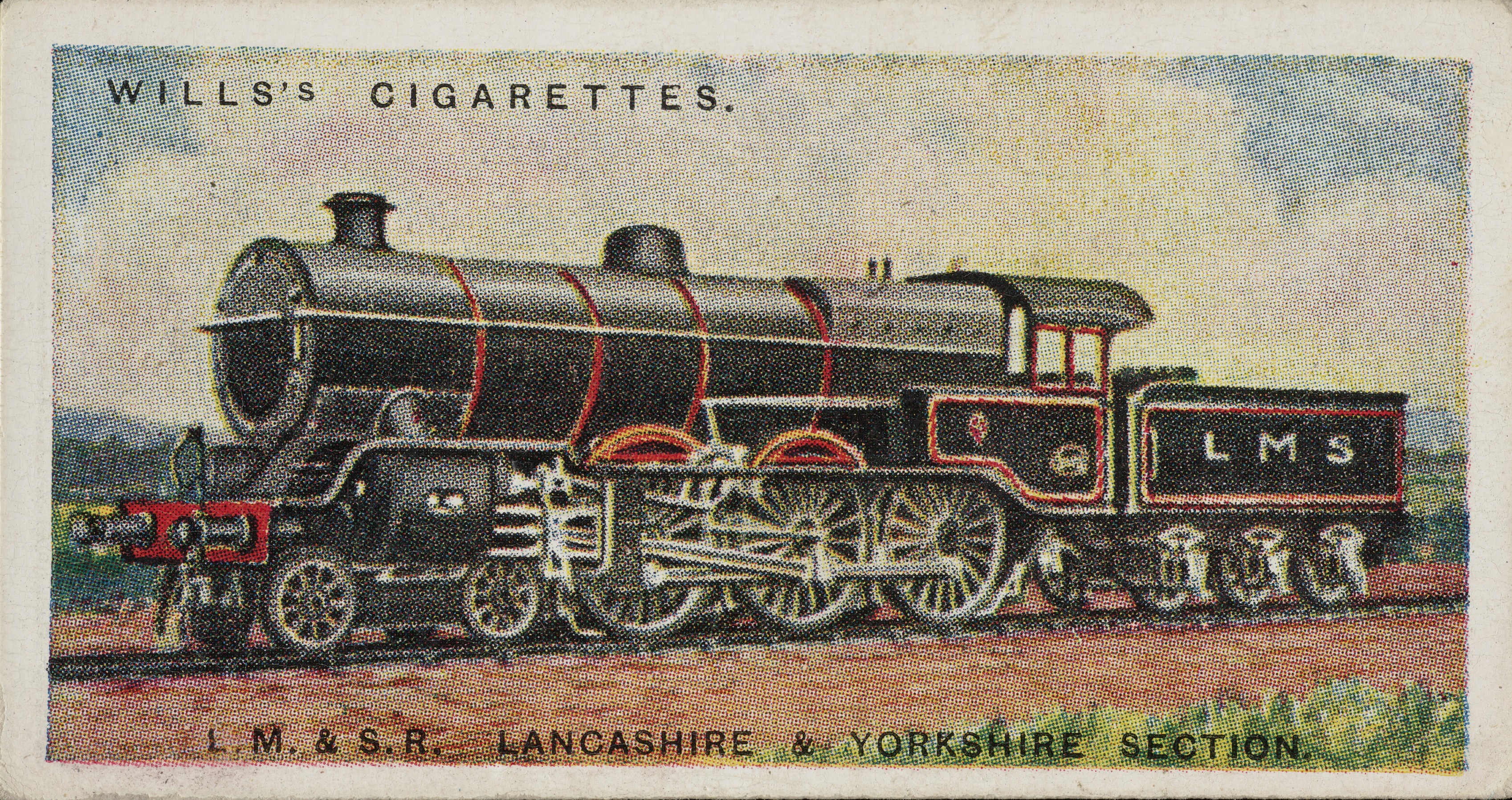
The John Rylands Library holds a wide variety of ephemeral printing, from ballads and broadsides to playbills and advertisements. However, while items in our Street Literature Collection have survived against the odds, these newly-acquired 20th-century British cigarette and trade cards were designed to be collected.

Practical Promotion
The invention of tobacco rolling machines in the 1880s enabled the mass production of pre-rolled cigarettes, offering an alternative to traditional tobacco pipes and cigars. Sold in paper packets, cigarettes were susceptible to damage, hence the introduction of a stiffener – a small piece of card inserted into the packet to stop the contents from being crushed or bent. Measuring approximately 2⅝ inches (67 mm) by 1⅜ inches (35 mm), these cards provided a ready-made promotional opportunity.
Originating in the United States, cigarette cards were soon popularised in the United Kingdom by firms such as W. D. & H. O. Wills of Bristol, John Player & Sons of Nottingham, and Gallaher Ltd of Belfast. Printed with pictures, and later, with accompanying text on the reverse, the cards were produced in numbered sets, usually of 25 or 50, covering a wide variety of subjects. Popular themes such as sports, transport and the armed forces were designed to appeal to young men, attracting them to a lifetime of consumption. Nicotine addiction apart, the collectable nature of cigarette cards encouraged repeat purchases and brand loyalty.
A Family Affair
Following the First World War, the tobacco industry extended its advertising to women, as female smoking in public became more socially acceptable. Likewise, cigarette cards continued to broaden their appeal by celebrating diverse aspects of British culture and history. With thousands of cards being produced by hundreds of companies, consumers could customise their collecting according to their individual interests:
‘Many interesting things have been illustrated (in series) on cigarette cards. Indeed, nearly all important events and people have had their own series of such cards’.
(Harmer, E. W., ‘What are Cigarette Cards?’ in The Boy’s Own Annual, Vol. 59, 1936-7, p. 472.)

The interest generated by cigarette cards extended from men and women to their offspring. ‘Fag’ cards were regularly collected and traded by children, who sought them from family members, from strangers, or even from empty packets discarded in the street. Spares could be swapped or gambled in various ‘flicking’ games. This popular pastime gave players the opportunity to win additional cards, commonly by landing their own card on that of an opponent, or closest to an agreed target.
Cartophily: The Hobby of Collecting Cigarette Cards
In an era before television and the internet, with limited access to illustrated books and periodicals, cigarette cards offered collectors a colourful window onto the world. In a competitive market rival manufacturers used novelty to stand out from the crowd. ‘Bird Painting’ (Godfrey Phillips, 1938) introduced an interactive element, inviting patrons to create their own miniature paintings using the template provided.

As the hobby of cartophily developed, some cigarette manufacturers issued albums to store and display specific sets. ‘Birds & Their Young’ (John Player, 1937) had adhesive backs to facilitate mounting. However, this approach had one main disadvantage:
‘In many albums the letterpress on the back of the cards is hidden, which is a pity, as there are interesting and instructive details in these small paragraphs, without which the pictures lose a lot of their value.’
(Robinson, H. A., ‘Improving Your Cigarette-Card Album’ in The Boy’s Own Annual, Vol. 61, 1938-9, p. 108.)
Readers of The Boy’s Own Annual were encouraged to overcome this drawback by creating their own albums which allowed both card ‘faces’ and backs to be displayed simultaneously.
Educational Value
The ‘interesting and instructive details’ crammed onto the backs of cigarette cards were valued as a cheap way for the working-classes to access knowledge. Ranging from historical facts and figures to biographies of contemporary celebrities, and up-to-date sporting records, the letterpress contributions were well-researched and achieved a reputation for accuracy. Mistakes and misprints were very rare. Errors, if discovered, were swiftly corrected.
One of the best-known inaccuracies occurred not in the letterpress, but in the picture itself. In this portrait of Benjamin Disraeli (1804-81), described as ‘a young man of twenty-two’, the artist Christopher Clark (1875-1942) has placed the dashing young author and future Prime Minister in front of the iconic Big Ben clock tower. Unfortunately, the clock tower (renamed Elizabeth Tower in 2012) was not completed until 1859.

Cigarette Cards and Imperialism
Issued during a period when the British Empire was at its height, cigarette cards provide a rich source of imperial and colonial imagery and information. Sets such as ‘Military Uniforms of the British Empire Overseas’ (John Player, 1938) and ‘Warriors of All Nations’ (Churchman’s Cigarettes, 1929) provide a glimpse into the breadth and structure of Britain’s armed forces, including soldiers recruited in Africa, India and Central America.
The heroic exploits of individuals during military campaigns were also popular. ‘Victoria Cross’ (John Player, 1914) tells the stories of recipients of Britain’s highest reward for gallantry. Conflicts covered include the Crimean War (1853-56), the Indian Rebellion (1857-58) and the Boer War (1899-1902).

Reflecting the dominant ideas of this expansionist age, military and colonial cigarette cards formed part of a wider network of popular culture, including imperial adventure stories, which would have appealed to young men and boys, while subtly promoting the benefits of Empire.
Rise and Fall
Cigarette cards enjoyed a golden age in the 1920s and 1930s. Some companies employed their own writers, artists and editors, and there was even a fan magazine, Cigarette Card News (London Cigarette Card Company, 1933). The magazine survives today as Card Collectors News. However, the outbreak of the Second World War heralded the beginning of the end for cigarette cards, as paper shortages halted production by 1940.
Although other trade cards, for example those issued by tea and confectionery companies, enjoyed success in the following decades, cigarette cards never regained their popularity. The Royal College of Physicians’ ‘Smoking and Health’ report (1962), which highlighted the harmful effects of smoking, led to restrictions on tobacco advertising and underpinned a change in societal attitudes towards smoking. Cigarette cards continued to be used sporadically until 2003, when they were banned under the 2002 Tobacco Advertising and Promotion Act. Ironically, the UK government is currently considering the use of cigarette pack inserts to provide health warnings and information on the benefits of quitting.
The Leslie Clarence Cigarette and Trade Card Collection
The Leslie Clarence Cigarette and Trade Card Collection was assembled by Leslie Clarence (1938-2021) of Salford, Lancashire, and was donated to the Library by his brother-in-law Alan James McHugh. The focus of the collection is 3,640 British cigarette cards, issued by 19 different companies from 1904-39, including 73 complete sets. There are also examples of cigar cards (1976-97), and non-tobacco cards issued by companies such as Cadbury’s and Brooke Bond PG Tips.

Although the number of smokers in Britain has steadily declined, the hobby of cartophily continues to be popular today, with cards being appreciated for their beautiful images, textual information and insight into historical popular culture.
Fascinating, Julie. My father, from Bolton, collected them as a child and he called them ‘tab cards’. His own father died from smoking-related lung cancer…