


Dr Janette Martin curator of the Modern History Archives writes:
May 2026 marks the centenary of the General Strike, one of the most turbulent periods in British industrial history. From 1 minute to midnight on 3 May 1926 until 12 May over 1.5 million key workers walked out in solidarity with striking coal miners who were facing longer hours and wage reductions. It was the first and only general strike Britain has seen and the country ground to a halt. Much to the strikers’ surprise, after 9 days of stoppages, the Trades Union Congress ended the strike. This was bitterly disappointing to those who had taken industrial action as there had been no concessions from the Government. Many felt betrayed. The miners were left to battle alone until the end of the year, when they returned to work on the employers’ terms.
Manchester’s printing presses fall silent
‘it would be dreadful if at the very moment when the saner parts of the press might do essential service it should be forcibly silenced’
This blog focuses on two stories told through collections held by The University of Manchester Library: how the news circulated during the strike, and the role played by students in strike breaking. Within the archives of the Manchester Guardian there is an intriguing telegram. Sent by the editor, C P Scott, on the eve of the dispute to the Leader of the Labour Party, Ramsay MacDonald, it urged him to do everything he could to keep the Guardian presses running during the strike. For “it would be dreadful if at the very moment when the saner parts of the press might do essential service it should be forcibly silenced.” While Ramsay MacDonald shared Scott’s misgivings, he was powerless to help.


A fascinating box of strike newspapers and bulletins within the Manchester Guardian Archive shows how both the authorities and strikers sought to control the news. The heavily unionised print workers stopped the presses entirely for the first two days of the strike and for the remaining days reduced the Manchester Guardian to a single sheet. This was significant disruption for a national daily newspaper which usually comprised 24 pages. Even when the strike ended, for several days the Manchester Guardian was a pitiful two sheets and four sides while Scott and the unions agreed terms around the return to work. Magnanimously, Scott said that there would be ‘no victimisation in respect to any action taken during the stoppage’ (Manchester Guardian, 16 May 1926).

During the disruption the newspaper proprietors had an old trick up their sleeves – the Gestetner. The Gestetner company celebrated its role in keeping the news circulating during industrial disputes. An advertisement in a 1920 strike bulletin noted, ‘during the dispute the news bulletins of the Manchester Guardian have been produced on Gestetner rotaries.’ Unlike the highly skilled work of typesetting and operating printing presses, this popular duplicator could be used by anyone, and during the 1926 General Strike newspapers across the country began to issue ‘no frills’ public bulletins at a penny a piece. A stamp on the reverse of the first bulletin issued by the Manchester Guardian on 6 May urged subscribers to display their copy in a window to help circulate the news further.


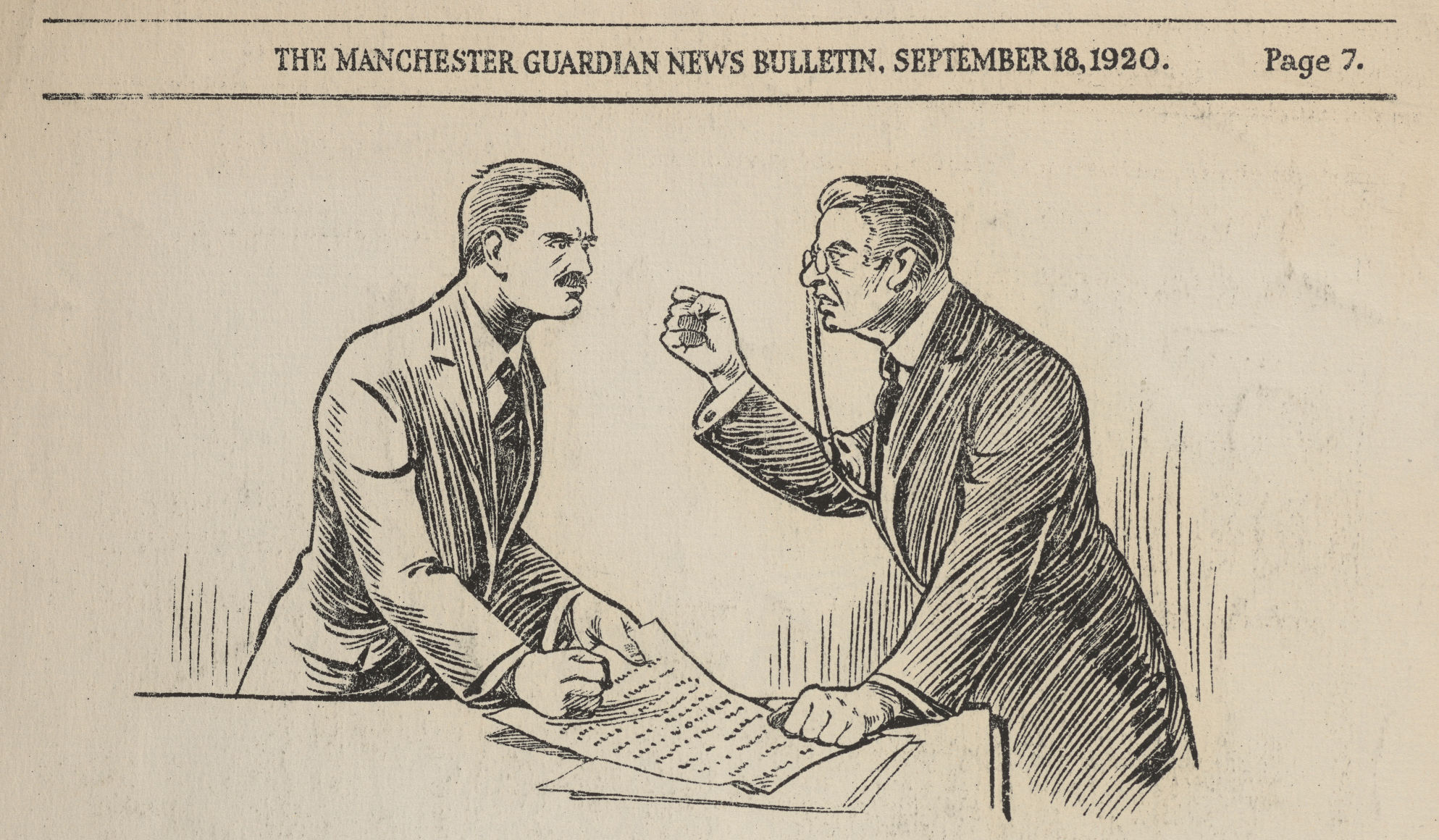
Other Manchester newspapers, including the Manchester Evening News and Manchester Chronicle, produced similar bulletins showing that there were managers or non-unionised staff willing to operate a skeleton news service during a strike. Such behaviour was ridiculed by the printers’ union, the Typographical Association, who during the 1920 printer strike produced a cartoon lampooning the bosses for whom ‘running a newspaper was a great stunt’. The cartoon depicts two men in conversation in front of a shop window papered with Gestetner bulletins: ‘publishing as usual’ says one, ‘Yes I don’t think’ says the other ‘I’ve bought one and there’s nowt in em’
Strikebreaking students
The General Strike caused a lot of headaches for the Victoria University of Manchester on several fronts. Correspondence in the Vice-Chancellor’s Archive documents a sharp demand for furnished rooms in Manchester as travel disruption created havoc for day students, with one poor chap describing long daily cycle rides from Bolton and back. There was also a lot of concern about impending examinations. Then as now the Vice-Chancellor’s office corresponded with other University leaders to see how they were responding to the crisis.
One of the most surprising things was just how many Manchester students and staff were willing to undermine the strike. The historian, Jonathan Schneer, notes that ‘the war spirit of 1914’ animated those that offered to help the country in 1926. Young men were loathe to miss the action and, compared to sitting examinations, aping the working classes was a bit of a lark. In Manchester the engineering students were the first group to offer their services. Some worked on the railways, others drove trams or unloaded freight on the Manchester Ship Canal. Students from other disciplines followed and their names and degree subjects are recorded in the file. Staff were also supportive and made the case that those undertaking ‘national service’ should not be disadvantaged in examinations.
A letter from a trainee teacher in Bowdon is one of several requests for permission to pause studies for the duration of the strike. In his case to work the LNER signal box at Timperley Junction. Incidentally, strikers warned the public not to travel on any services operated by volunteer labour – wise words, as there were several fatal rail and tram accidents during the 9-day stoppage.

The University knew that intervening in a labour dispute was a risky business and didn’t wish to be seen as taking sides. A report in the Manchester Guardian Bulletin, 8 May 1926, captured the delicacy of the situation. In response to complaints of students driving Corporation buses the Pro Vice-Chancellor is quoted as saying ‘it was done individually without pledging the University.’ This was somewhat disingenuous as several senior academics were actively working with the Volunteer Services Committee to recruit men. Notably the Principal of the College of Technology who sent 100 engineering students to the Ship Canal on the 10 May 1926. In a letter to the Vice-Chancellor, he justified his actions by stressing that he had been assured that they would only unload food. He hoped this would protect the University from “the charge of strike breaking or taking sides”.
Perhaps it was fortunate for the University that the strike ended before the participation of students and the University’s tacit support became known.
General Strike open day
On Saturday 9 May 2026, the People’s History Museum in Manchester hosted an open day to mark the centenary of the 1926 General Strike. At this event academics, activists, trade unionists, and heritage professionals explored the 1926 General Strike, its legacy and significance. The event was a collaboration between The University of Manchester, the National Co-operative Archive, People’s History Museum, and Working Class Movement Library, with support from the Society for the Study of Labour History.
You can see the final programme here
SOURCES
A selection of General Strike material will shortly be available in our digital viewer
Manchester Guardian Archive (Ref GDN 256/5)
University of Manchester Archives (Ref. VCA/7/185)
Papers of Frank Andrews, trade unionist and printer (uncatalogued)
Papers of David Arnold Wilson (1897-1981), railway clerk, trade unionist and socialist, includes a personal reminiscence of the General Strike in Bradford
Ramsay MacDonald Papers includes General Strike materials documenting the entire course of events, from the problems of 1925 to post-dispute commentary.
Books:
Keith Laybourn The General Strike of 1926, Manchester 1993
Jonathan Schneer, Nine Days in May: the General Strike of 1926, Oxford 2026
0 comments on “Stories from Manchester’s General Strike: Silent printing presses and strikebreaking students”