

PhD student Ellesse Patterson reflects on the relationship between The John Rylands Library and one of Britain’s most notorious literary forgers, Thomas J. Wise, illuminating a forgotten corner of the Library’s history. This work was supported by the Arts and Humanities Research Council (grant number AH/R012733/1) through the White Rose College of the Arts & Humanities.
In 1934, the renowned literary bibliographer, Thomas J. Wise (1859-1937), was unmasked as a forger and thief who had hoodwinked the book-collecting world for decades. John Carter and Graham Pollard used a combination of typographical analysis, forensic investigation of paper types and archival research to implicate Wise in the creation of forty-six fraudulent publications. An Enquiry into the Nature of Certain Nineteenth-Century Pamphlets identified forged first editions and other rarities by prolific authors including Elizabeth Barrett Browning (1806-1861), John Ruskin (1819-1900), George Eliot (1819-1880), Robert Louis Stevenson (1850-1894) and many more.
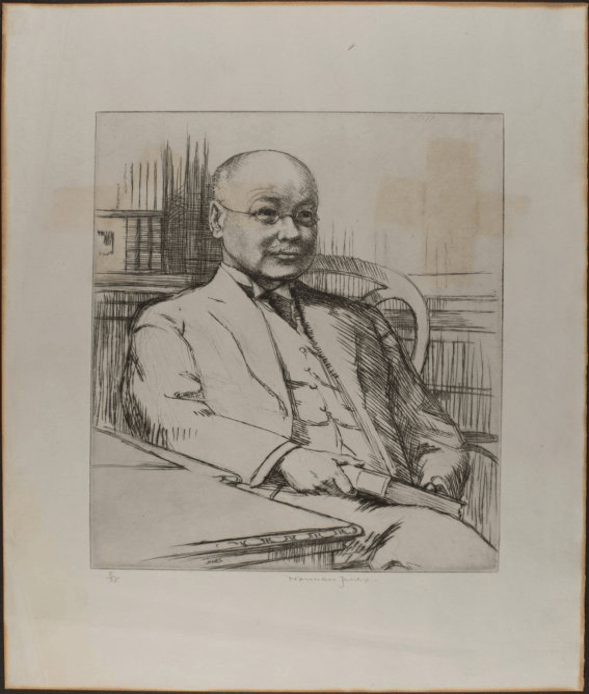
Wise was proclaimed “The Moriarty of the Book World” by Dr Joseph Hone in The Book Forger, a page-turning account of Wise’s crimes and the investigation that finally exposed him (Hone, p.124). In the decades since Wise’s death, the number of identified fraudulent pamphlets has risen to over one hundred. These forgeries have appeared on the shelves of illustrious institutions from Texas’s Harry Ransom Center to the British Library. But his connection to Manchester’s own John Rylands Library is less well-known.

Fraud and Facsimile Copies
As a forger, Thomas J. Wise’s work was cunning indeed. Where other book forgers falsified ‘lost’ papers by a famous author (as William Henry Ireland did with his Shakespeare forgeries), Wise’s experience with creating pamphlets for The Shelley Society allowed for a more subtle approach. While Wise’s facsimiles of Percy Shelley’s work were acknowledged as his own publications, later forgeries were distributed and sold anonymously as rare editions commissioned privately by authors for their friends and family.
To even the most discerning eye, Wise’s forgeries looked like authentic rarities that book collectors like the founder of the Library, Enriqueta Rylands (1843-1908), wouldn’t hesitate to snap up.
Traces of Wise in The John Rylands Library
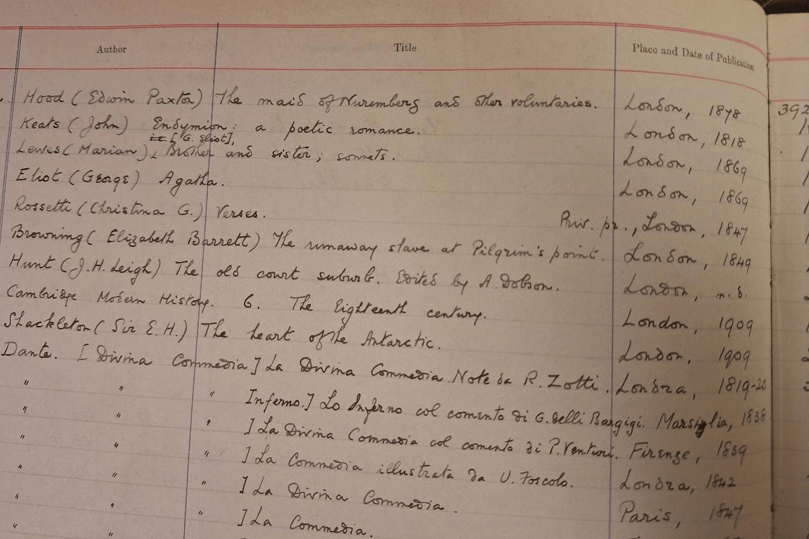
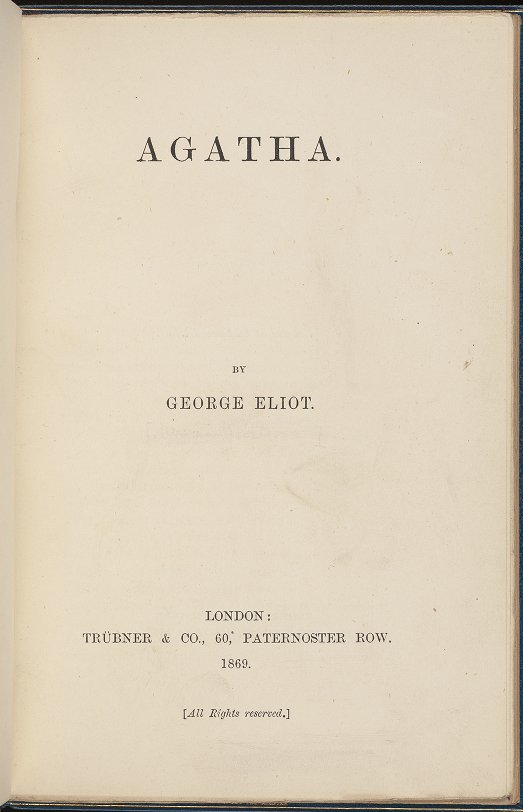
The image above shows an Accession Register documenting some of the books that Enriqueta Rylands privately acquired and bequeathed to the Library on her death in 1908. Listed on this page are three of Wise’s forgeries: George Eliot’s Brother and Sister Sonnets and Agatha, alongside Elizabeth Barrett Browning’s The Runaway Slave at Pilgrim’s Point.
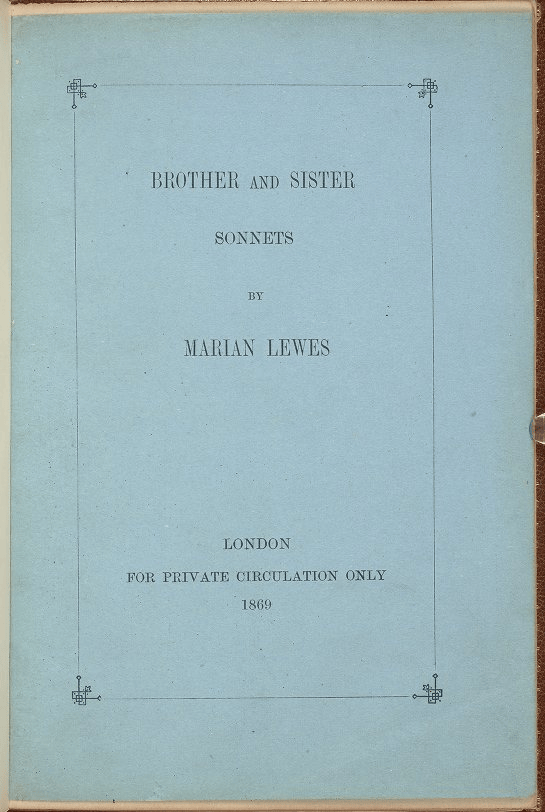
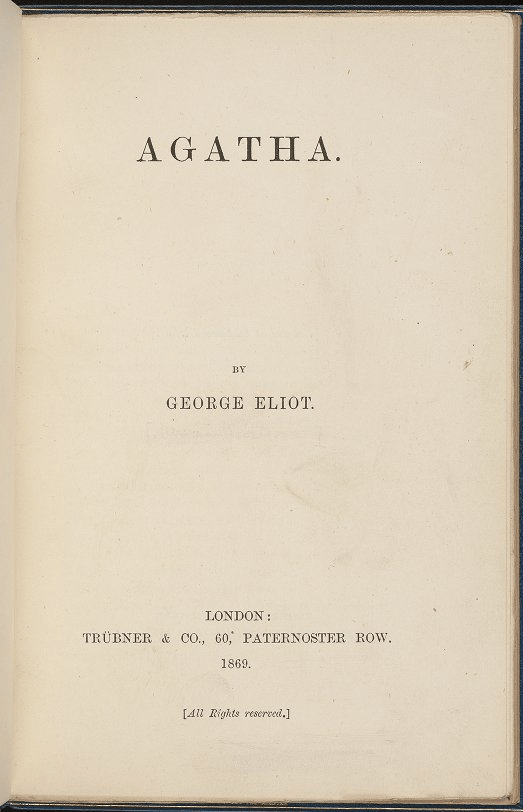
In Wise’s forgery, Eliot appears to have issued her Sonnets not under her pen-name, but as Marian Lewes. The copy of Agatha purchased by Rylands is a counterfeit copy of the genuine first edition. Barrett Browning’s Runaway Slave is stated to have been published in London in 1849. In truth, this piece wasn’t printed in Britain until 1850 where it appeared in the second edition of Barrett Browning’s collected Poems, rather than as a single work. These books were part of Rylands’s private library and we do not know how she acquired them.
That the Rylands was an unwitting recipient of Wise’s forgeries cannot be disputed. To this day, the Library holds approximately 100 of Wise’s forgeries in their Special Collections, with others perhaps still awaiting discovery by keen-eyed readers. This begs the question: What precisely was the relationship between The John Rylands Library and Wise?
Wise: Advisor of The John Rylands Library?
In a letter sent to Professor Newman White at Duke University, North Carolina, on 6th December 1931, Wise credits himself with an influential role in the creation of The John Rylands Library:
The fact is I have throughout the greater portion of my mature life had a great deal to do with the formation of public libraries of character. I was one of the advisers of Mrs. Rylands and Dr. Green when the Rylands Library was in course of formation.
Wise, Letter to Professor White, published in Ellen Frances Fox, ‘Thomas James Wise: Friend of Duke University Library’, 1947, p.7.
There is no evidence to support Wise’s audacious claim in any of the Library’s records. Although The John Rylands Library archive contains correspondence from Wise to the Head Librarian, Henry Guppy, well into the twentieth century, this handful of letters contains little more than pleasantries between two respected members of the bibliographical world.


No direct correspondence between Wise and Enriqueta Rylands has ever been found, nor is the forger mentioned in the letters to Rylands from Dr Samuel Gosnell Green and his son Arnold, who worked as her book agent. To evade detection, Wise moved fraudulent pamphlets through various booksellers and auction houses, making it nearly impossible to trace the forgeries back to him.
Like so many other literary experts and collectors of the day, Enriqueta Rylands and her librarian were both deceived by Wise. However, the forger’s evident interest in trading on The John Rylands Library’s reputation highlights its growing significance at the turn of the century, as well as the long-forgotten influence that Enriqueta Rylands’s collecting had on American libraries.
Although Carter and Pollard’s An Enquiry documents the location of Wise’s identified forgeries in exquisite detail, Wise’s dealings with Enriqueta Rylands and the Library have been largely relegated to the footnotes of history. In connection with The Forgotten Library exhibition (where you can see two George Eliot forgeries, until 31 October), Ellesse’s research project aims to shine a light on this shadowy corner of book history.
To discover more, join Ellesse on Wednesday 2 September 2026 for a collection encounter on The Forgeries of Thomas J. Wise and watch this blog for a follow-up post examining the impact of Wise’s forgeries on the literary afterlives of the authors he imitated.
Find out more
The Ashley Library of Thomas J. Wise – British Library English and Drama blog
The perfect crime: loose leaves and Thomas J Wise’s made-up books (British Library blog)
Creative Forgeries: Thomas J. Wise and His Fictitious Imprints – Things Aren’t What They Seem: Forgeries and Deceptions from the University of Delaware Collections
Joseph Hone, The Book Forger: The True Story of a Literary Crime that Fooled the World (Vintage, 2024).
Famous Forgeries in Book History: The Case of Thomas James Wise from the University of Oregon
Elizabeth Gow ‘Feature Article: Enriqueta Rylands: A Study of Private Collecting and Public Philanthropy, 1889-1908’. Library and Information History Group News, Winter 2019.
0 comments on ““The Moriarty of the Book World”: Thomas J. Wise at The John Rylands Library”