

Content warning: This post discusses family connections to slavery and the plantation economy in 19th-century Cuba. These histories reflect the inequalities and exploitation of the period and are not condoned by The University of Manchester.
In my previous post, Returning to the Reunion Deseada, I introduced a remarkable plan and group of photographs of the Cuban sugar estate that belonged to the family of Enriqueta Rylands. This plantation may seem far removed from the library she founded, but their histories are connected through family, friendship and international trade. This post traces these connections through photographs taken in Matanzas, Baltimore, Bremen, Paris and Manchester.
Family matters in Matanzas

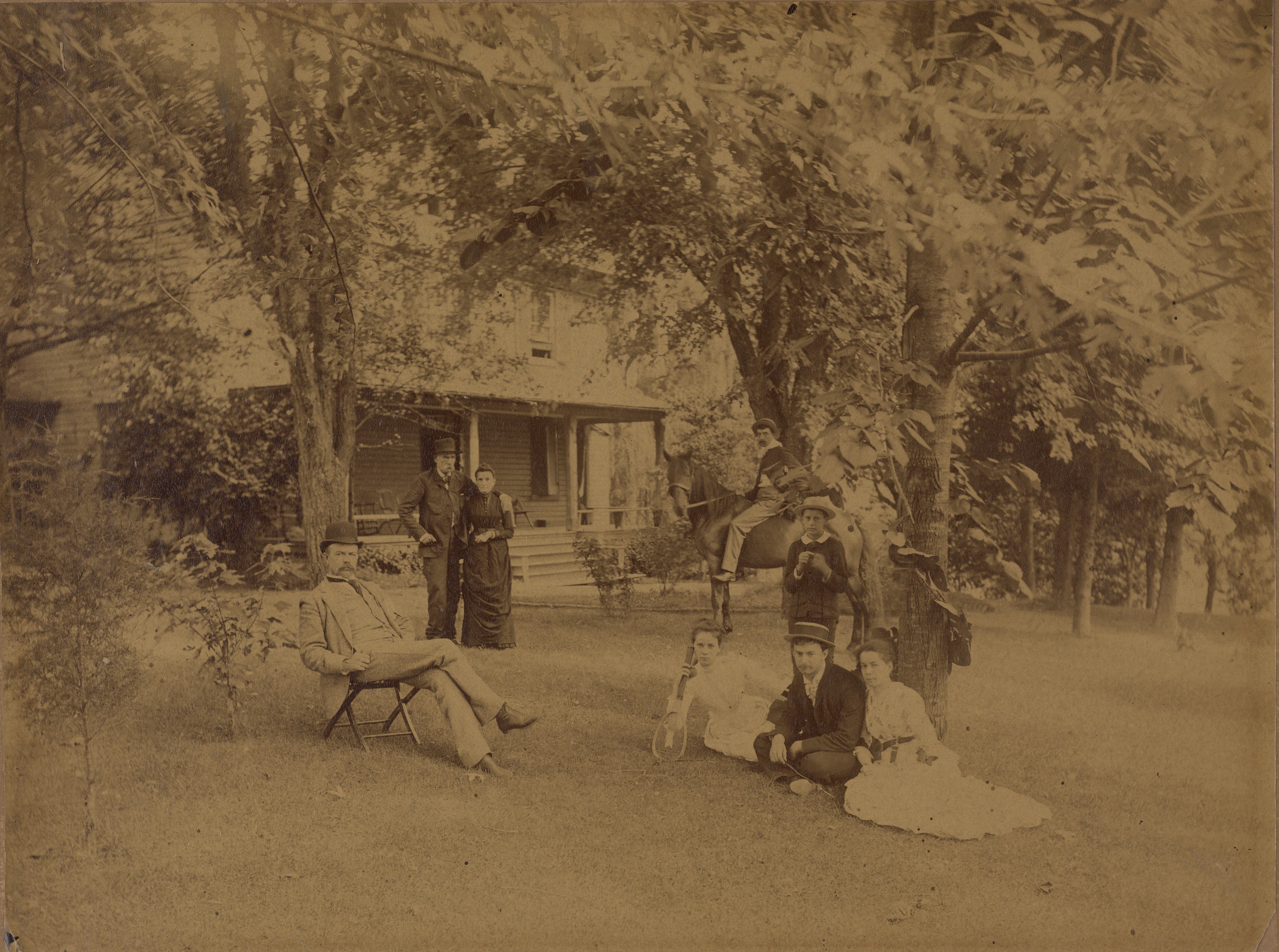
This is the clearest image of family members among the six photographs taken at the Reunion Deseada. It probably depicts Teodoro or Augustin Dalcour with the de Bullet sisters. The photographs are probably the work of an amateur – these are not images to sell to tourists. It is possible they were taken by one of the Dalcour brothers, who had travelled widely in America and Europe, or their brother-in-law, the self-styled ‘Comte de Bullet‘ (an enthusiast for ‘spirit photography’ living in Paris).


The collection also contains two photograph albums containing carte de visite portraits of friends and family. Because of their fragility, we haven’t removed the photographs from their mounts. But in some cases, the back of the photograph is visible, enabling us to identify the sitter. This dapper gentleman is Emilio Buch (1833-1900), whose portrait was taken at the Matanzas studio of Louisiana-born entrepreneur Julio H. Normand. On 3 June 1865 Emilio inscribed the reverse to Guillermina Bastian de Traub (1839-1900), presumably the woman in the adjacent portrait. The back of her photograph is covered by a painting of flowers.


Emilio’s portrait also appears in the second album alongside another young woman, presumably Guillermina’s sister Dolores (1840-1907), who Emilio names in his inscription. The reverse of her portrait shows it was taken in New York by celebrity photographer J. Gurney & Son. Emilio may have given his portrait to the sisters as a mark of affection, but he does not appear to have become part of the family. Within a few years, all three were married: Emilio to Eliza Baldwin, Dolores to John Prince Bayley (another plantation owner in Cuba) and Guillermina to the Comte de Bullet’s younger brother Eugene.
Matanzas to Baltimore
The family were interested in new photographic techniques. As well as albumen prints, the donated collection contains daguerreotypes, ambrotypes and tintypes, forms of photography which arrived in Cuba in the 1850s. These two portraits of Augustin Dalcour were taken less than ten years apart. His passport application of 1875 describes him as 6 feet tall, with a high forehead, grey eyes, a full nose and medium mouth, a full face and “greyish” hair. It does not describe his distinctive beard.

The framed ambrotype was taken by a studio photographer, probably in Matanzas or Havana. The cabinet card was made in Baltimore City by N.H. Busey, after Augustin Dalcour left Cuba for the United States in July 1870.


Across the Atlantic: Bremen and Paris
My two favourite photographs in the collection were taken in Europe. This portrait of two young women, in an oval frame, was taken in Bremen by the photographer Emil Tiedemann. There is a faint inscription on the back: “Matilda and Malinke” – possibly the Traub sisters Mathilda (born 1824) and Amelie (born 1820).

VPH.347.temp.11.3)

This charming cabinet card, by Melandri of Paris, depicts the novelist Victor Hugo with his grandchildren Georges and Jeanne. I was surprised to find it among these family photographs, although there are a few other celebrity portraits. Melandri would have sold copies in his Paris shop, where the Comte de Bullet might have bought one to send to his sister in Baltimore.
The Manchester connection


This page in the album includes a photograph taken at the photographic studio of Reston in Stretford, just around the corner from Enriqueta’s home at Longford Hall. It almost certainly depicts Harriet, the wife of Enriqueta’s twin brother Stephen Joseph Tennant. She is holding a baby, probably Blanca who was born in 1879. (A cabinet card by the same photographer shows her older sister Clarita at age two years and seven months).
It would make sense for the portrait of Harriet to sit alongside that of her husband. He has different facial hair and expression than in the portrait possessed by his descendants, but the eyes are similar. This photograph was taken by José Ferreira Guimarães in Rio de Janeiro, where Stephen Tennant went in 1880 to recover a debt due to Rylands & Sons, the firm led by his brother-in-law John Rylands.
Together, these photographs map a family world that stretched from Cuba and the United States to Europe. The John Rylands Library is a legacy of this transatlantic story.
Find out more
- Historic Camera Collector Club. ‘Norval H. Busey’ and ‘Charles D. Fredricks’. Historic Camera (2014).
- Kirsty de Loose, ‘Who Am I? Unidentified Daguerreotype New To Our Collections’. Rylands Blog (2022).
- Radio 26 – Matanzas, ‘Los fotógrafos de Contreras 41’ (2023).
- David S. Shields, ‘Studio, Gurney and Son’ and ‘Charles Deforest Fredricks’. Broadway Photographs (Accessed 16 October 2026).
- Frances Varley, ‘Cuba to Castlefield: Religion, Empire, and Philanthropy in the John Rylands Library’. Journal of Victorian Culture 31, no. 3 (2026): 175–94.
0 comments on “Rylands Reflects: From Matanzas to Manchester”