


By Molly Sutherland, University of Manchester MA Library and Archives student.
In May I finished a 20-day placement with the Imaging Team at The John Rylands Library as part of my MA in Library and Archive Studies. During this placement, we digitised glass plate negatives believed to date from the 1900s – 1950s. Numbering in the thousands and varying in size, these negatives have remained uncatalogued in storage, accompanied by little or no metadata.
Digitising the Negatives
The digitisation process involved photographing the negatives using transmitted light. Light passes through the plates while a camera mounted above captures the image.
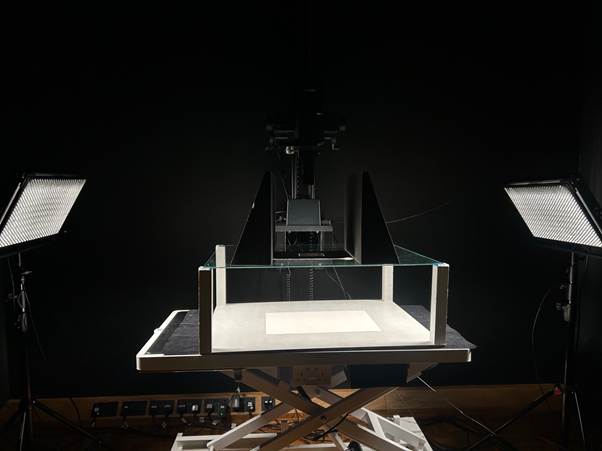
Our initial setup involved positioning lights at 45-degree angles on either side of a copy stand. The negative was elevated on glass above a white surface, allowing light to pass through evenly, while foam blocks were used to control light spill. This is the setup the team use for papyrus, magic lantern slides and larger glass negatives.
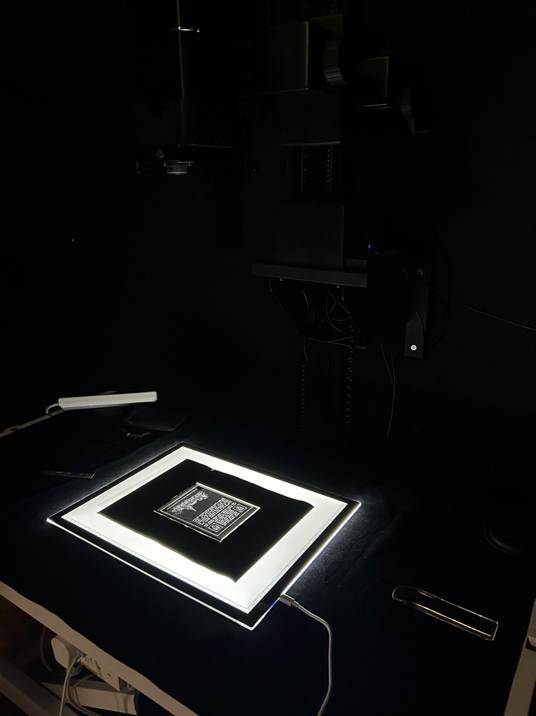
In our third week, we changed the setup. Some of the negatives were found in their original envelopes, which contained metadata needing to be captured. Lowering the table each time for the envelopes was time-consuming. Instead, we placed the material on an LED light sheet – turning the side lights on to photograph the envelopes.
Using Capture One software, the digitised negatives are converted into positive images. As the plates are photographed emulsion-side up to avoid damaging the emulsion, the images must first be flipped horizontally. Colour information is then removed and tonal values inverted. Black becomes white and vice versa, producing a positive image.
Finally, the image is cropped and rotated ready to be uploaded onto Library Digital Collections (LUNA).


A Brief History of Glass Plate Photography
Glass plate negatives played a central role in photography from the mid-nineteenth century until the widespread adoption of film. Early photographic negatives were produced using the collodion wet plate process, coating glass plates with light-sensitive collodion emulsion containing silver salts, exposed in the camera, and developed immediately afterwards. Since the plate had to be processed before the emulsion dried photographers frequently carried portable darkrooms with them.
The introduction of dry plate technology in the 1880s transformed photographic practice. As the emulsion was dried before use, plates could be manufactured commercially, stored for extended periods and transported easily. This innovation made photography more efficient, paving the way for the expansion of both amateur and professional photography.
Photography at The John Rylands Library
The role of photography at The John Rylands Library has remained remarkably consistent. The Rylands Heritage Imaging Lab plays a central role in preserving and providing access to the Rylands’s extensive collections, facilitating research, teaching, conservation and public engagement activities.
The photography of the collections at the Rylands extends back before the library opened. As Gow et al. state, the library’s founder, Enriqueta Rylands, was a keen photographer who maintained a photographic room at her residence Longford Hall in Stretford.

In 1910, the library established a photographic studio in a room originally intended as the kitchen. The studio remained there for half a century, until an extension funded by the Wolfson family was constructed at the rear of the library in the early 1960s.
Prior to this, researchers wishing to obtain photographs of items were advised to employ the services of external photographers. The librarian claimed that the decision to create a photographic studio was “abundantly justified” by the service it rendered to researchers.

The first designated ‘photographer’ was not employed until 1961. The staff members involved in imaging were not photographers but librarians. Not all the photographs they took were of professional quality.
Looking Ahead
The glass plate negatives digitised during my placement represent more than historical photographs. They are evidence of the Library’s longstanding commitment to documenting and sharing its collections. Through digitisation, these fragile objects can be made accessible to researchers while reducing the need for physical handling.
Among the photographs of books and manuscripts we discovered something unusual – a group of photographs associated with the manuscript collector and scholar James Rendel Harris. In my next post, I’ll explore this discovery in more detail.
Find out more
Bosham Gallery (2024) What Is A Glass Plate Negative?
Poultney Vermont Historical Society (no date) How Glass Plate Negatives were made
E Gow, J Hodgson, J Richards, and T Robinson (2025) ‘‘Fraught with Possibilities of World-Wide Benefit’: Towards a History of Photography at the John Rylands Library’ in Bulletin of the John Rylands Library, 101(2), pp. 15 – 33
A marvellous blog post, Molly. I was fascinated to learn about the process of photographing the glass plate negatives, and can’t wait to hear more about the Rendel Harris material.