


By Molly Sutherland, University of Manchester MA Library and Archives student. This is the second blog in a series.
My previous post discussed my placement digitising glass plate negatives with the Imaging Team at The John Rylands Library. Among the most compelling discoveries during the project were 22 negatives labelled “Rendel.”
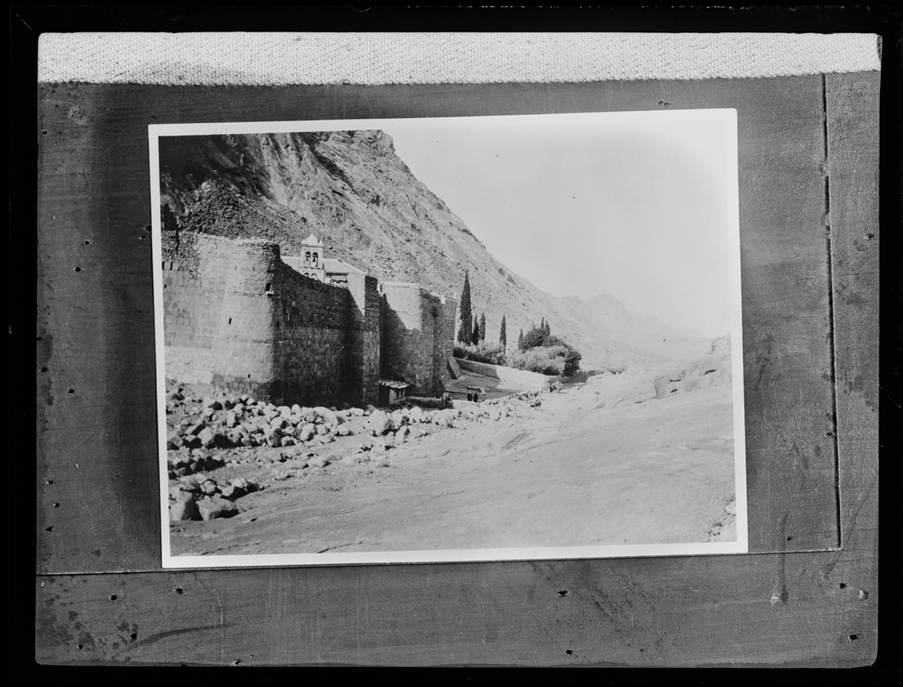
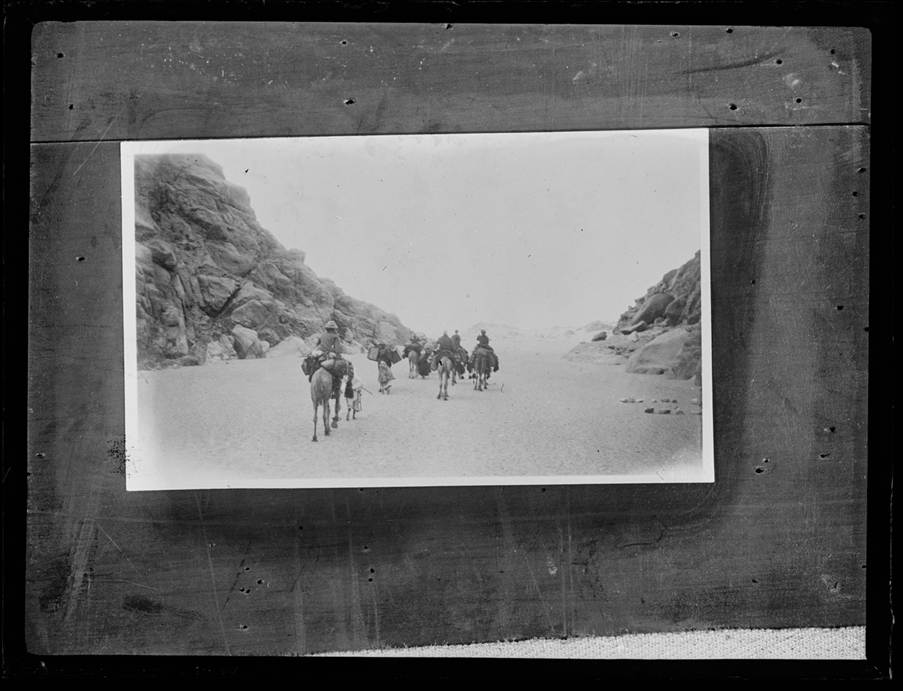
The glass negatives show copies of photographic prints depicting desert landscapes, camels and manuscript scholars. Senior Photographer Tony Richards identified one of the locations as Saint Catherine’s Monastery in Egypt.
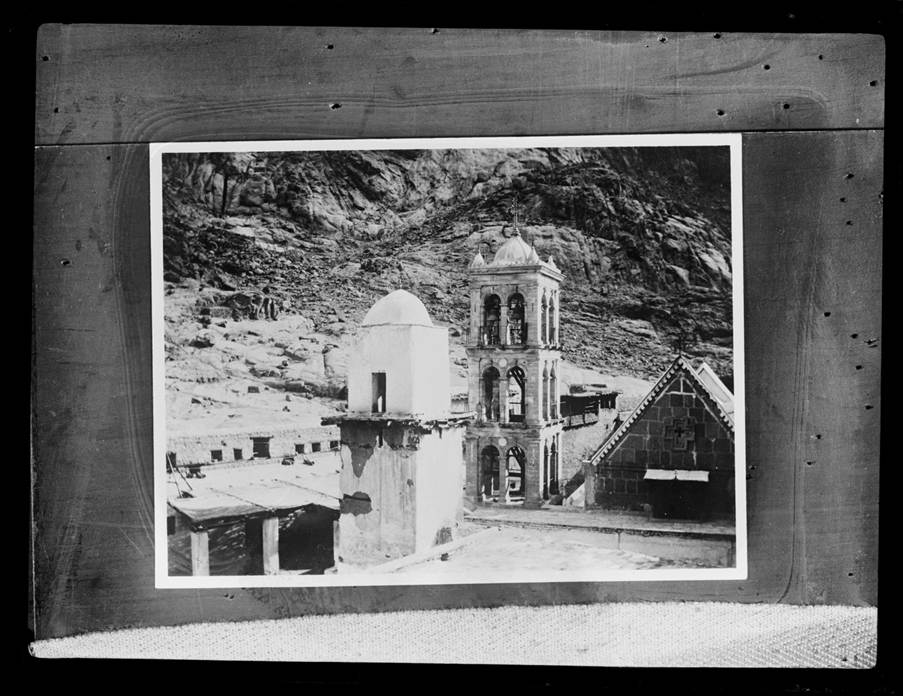
Visible in the negatives is the wooden board the original photograph rests on. The negatives were probably used to make lantern slides for a lecture. Glass plate negatives were often copied onto magic lantern slides for the purpose of projecting them onto a wall during a public lecture.
St Catherine’s Monastery
St Catherine’s Monastery, at the foot of Mount Sinai, is the world’s oldest operating Christian monastery. Founded in the sixth century, it remains home to a small Greek Orthodox community and is a UNESCO World Heritage site renowned for its ancient library and the Chapel of the Burning Bush.
The library is home to over 3,300 manuscripts and 8,000 early printed books, housing one of the largest collections of early codices and manuscripts.
Its collections have also been shaped by a history of colonial acquisition. The best-known example is the fourth-century Codex Sinaiticus, removed by Constantin von Tischendorf in the 1840s. While Tischendorf maintained that the manuscript was gifted to him, the monastery has long disputed his account.
Two of the glass negatives appear to show the monastery’s ossuary, where the remains of generations of monks are preserved. One depicts a collection of skulls, while another shows a seated skeleton draped in robes and pearls. We have chosen not to reproduce these images here out of respect.
James Rendel Harris and the Search for Manuscripts
One particularly striking negative shows James Rendel Harris wearing a fur coat beside a monk at St Catherine’s, holding a manuscript towards the camera. A similar photograph, dated 1923, survives in the Library of Congress collections.
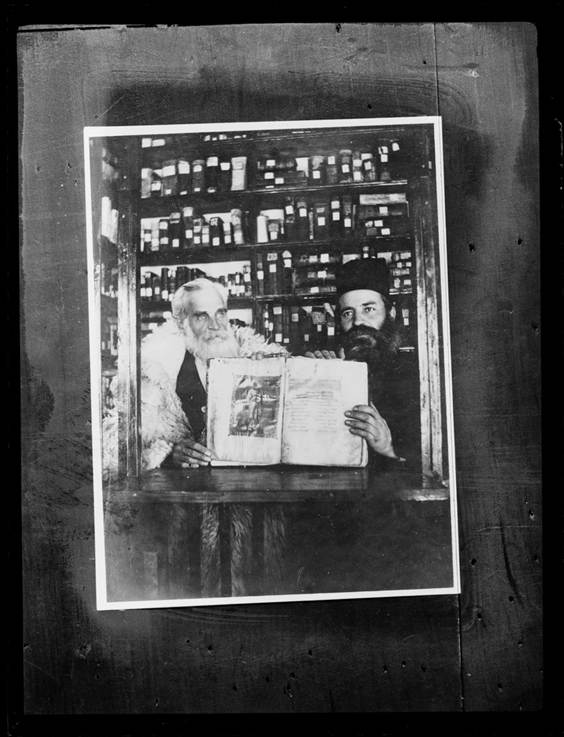
James Rendel Harris (1852–1941) was an English biblical scholar, manuscript collector and later Curator of Manuscripts at The John Rylands Library. After studying mathematics at Clare College, Cambridge, he became Professor of New Testament Greek at Johns Hopkins University before establishing his reputation through expeditions across the Middle East in search of early Christian and biblical manuscripts.

From 1888 onwards, Harris acquired manuscripts in Hebrew, Arabic, Syriac and Ethiopic. Several manuscripts he collected are now held at The John Rylands Library, including Syriac MS 9, MS 10, MS 16, MS 24, MS 30, MS 33, MS 44 and MS 52 (some available on Manchester Digital Collections). In some cases, it is unclear the circumstances under which Rendel acquired these texts – he claims to have found Syriac MS 9 on a shelf in his office.
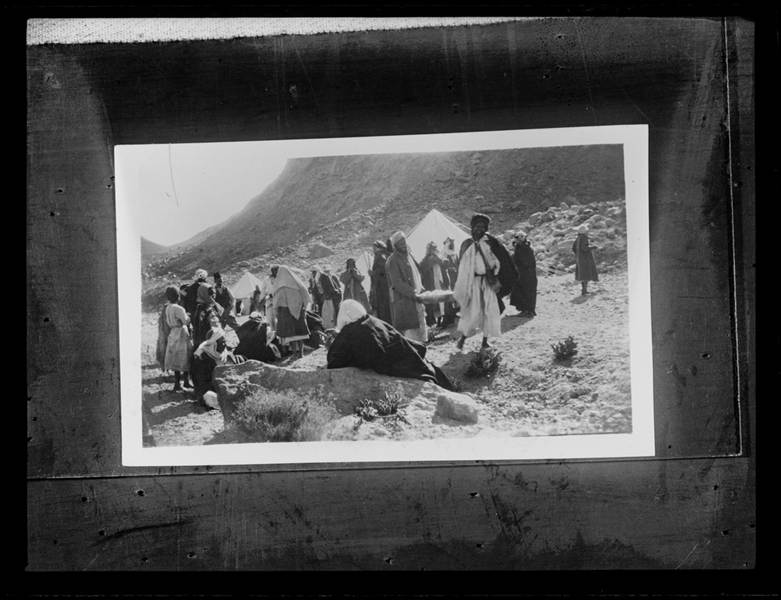
Harris developed close ties with the community at St Catherine’s Monastery, especially the librarian Galaktéon. These relationships helped facilitate the work of the twin scholars Agnes Smith Lewis and Margaret Dunlop Gibson, who became known as the “Sisters of Sinai”, whose discovery of the Sinaitic Palimpsest transformed the study of the Syriac New Testament. Harris later joined expeditions with Robert Bensly and Francis Crawford Burkitt to study the manuscript.
War and Loss
During the First World War, Harris twice narrowly escaped disaster at sea. In 1916, while travelling to India, his ship was torpedoed in the Mediterranean, though he was rescued to Alexandria.
On his return journey the following year, he travelled with his colleague James Hope Moulton. Their ship was torpedoed and, after several days in a lifeboat, Moulton died from exposure while Harris was rescued and taken to Corsica.
Writing from the Grand Hotel in Ajaccio on 18 April 1917, Harris expressed his grief to Henry Guppy, the librarian at the Rylands:
Such a sorrow would have fallen upon us both as is involved in Dr. Moulton’s removal. These last years have united us three in close collaboration and sympathy. He helped to bring me into the arc of the Ryland’s activities… during these last days on ship-board together we had been organising delightful plans to the effect that I was to come and live with him in Manchester… where we were going to work together.

Between these two voyages, Harris had collected manuscripts in Cairo, Asyut, Fayyum and Oxyrhynchus. Fortunately, they had remained in Egypt and escaped the second shipwreck before entering the Rylands’s collections in 1917.

Bringing the Negatives into Focus
The glass plate negatives digitised at The John Rylands Library likely date from Harris’s tenure as Curator of Manuscripts, a role he held after moving to Manchester in 1918 until his retirement in 1925. From Ansorge’s blog and the date of the Library of Congress image, it is likely that these photographs are from Harris’s last trip to Sinai in 1923. These once-neglected materials will be made publicly accessible on the University of Manchester’s Library Digital Collections (LUNA), bringing into sharper focus the pursuit of lost texts.

Find out more
Alessandro Falcetta, The Daily Discoveries of a Bible Scholar and Manuscript Hunter: A Biography of James Rendel Harris (1852–1941), (2018).
Bart Ehrman, My Trip to Saint Catherine’s Monastery on Mount Sinai: Discovery Site of Codex Sinaiticus (2023).
Catherine Ansorge, ‘James Rendel Harris: a Bible scholar on a quest for manuscripts’. Cambridge University Library Special Collections (2021).
J. F. Coakley (1993) ‘A catalogue of the Syriac manuscripts in the John Rylands Library’, Bulletin of the John Rylands University Library of Manchester, 75(2), pp. 105–207.
Janet Soskice, The Sisters of Sinai: How Two Lady Adventurers Discovered the Hidden Gospels, (2009).
Mount Sinai Monastery. ‘Home’ (no date).
A great second blog post Molly. I wonder what other historic staff content there is at the Rylands.