

Dr Josephine Tierney reflects on how a conversation at one of the library’s Collection Encounters led to an exciting discovery, illuminating Manchester’s global connections past and present, and expanding our knowledge of the collections.
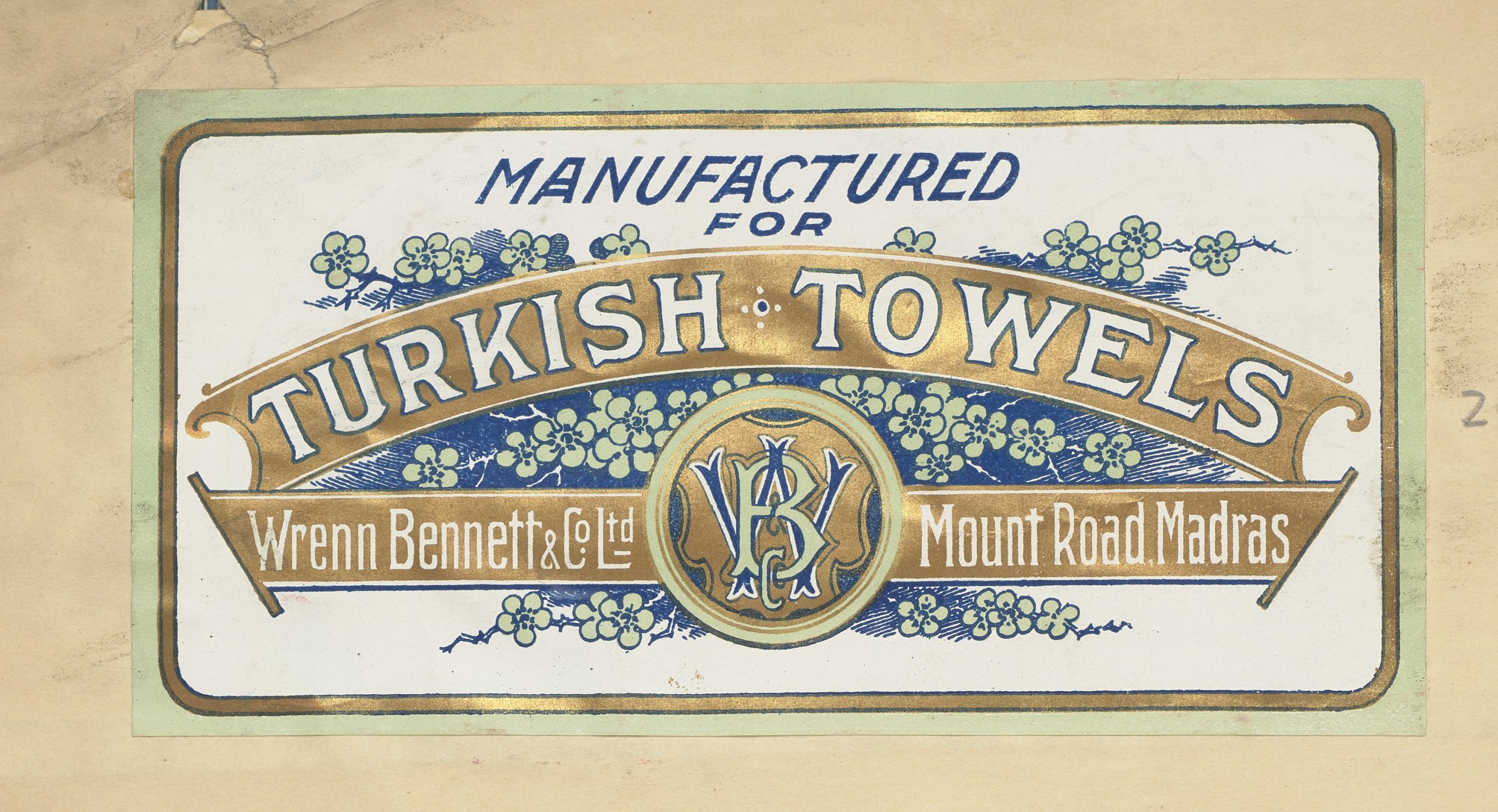
During a recent Collection Encounter for the temporary exhibition Cottonopolis: The Origins of Global Manchester, visitors were introduced to a volume of packing labels from the towel manufacturers W.M. Christy & Sons Ltd. This leather-bound volume, containing around 200 labels produced by the firm between 1910 and 1920, captures the global mercantile networks that Christy & Sons were part of.

Collection Encounters and Co-Creating Knowledge
These vibrant labels caught the eye of three of our visitors. They remarked on the many places around the world and the different languages that are depicted on the labels. They were particularly interested in one label featuring the words ‘The “Arabic” Turkish Towel’ encased in gold cartouches on a background of vivid red. In the very centre of the label on a red banner, below a gold crescent and star, is a line of Arabic script.

The three young women, all Arabic speakers, were intrigued by the appearance of this Arabic script in a volume of labels produced in Manchester. After some discussion, the women were able translate the text, suggesting that it likely reads as ‘Henry Bizman & Sons in Manchester.’ Together with Curator Janette Martin, we were able to determine that the text was probably the name of a merchant firm or shipping agent who commissioned Christy’s towels and exported them to Arabic speaking countries.

With a new understanding of the text used on the labels thanks to our visitors, Janette and I were able to use our knowledge of Christy’s history and the wider historical context of Manchester’s global trade to explain why these labels might include Arabic script.
Christy & Sons Ltd and the Royal Turkish Towel
Christy is a well-known name today for high-quality, luxury towels but their heritage dates back to 1850 when Henry Christy returned from Turkey with an unusual, looped fabric that was highly absorbent and soft to the touch. Inspired by the properties of the fabric, Henry, his brother Richard and employee Samuel Holt produced the first industrially made, looped towel. Their innovation became known as the ‘Turkish’ towel and was presented at the Great Exhibition in 1851.
The ‘Turkish’ towel became Christy’s leading product and by 1922 an article in The Manchester Guardian boldly claimed that Turkish towels were ‘now made to perfection, not in Turkey, but in Manchester.’1 Christy developed their brand as the ‘original inventors and patentees of the Royal Turkish towels’, a claim that appears often on their packing labels.2 By the 1890s their factory in Droylsden had over 700 looms and Christy products were exported across the globe.

Manchester’s Global Mercantile Networks
The packing labels illustrate how widely Christy towels were exported and consumed. The labels confirm that Christy were manufacturing towels for sale as far as Vienna, Paris, Tunis, Madras, Singapore and Sydney. They were also exporting their ‘Turkish’ towels to cities within the Ottoman Empire such as Cairo, Beirut, Salonica (Thessaloniki) and Constantinople (Istanbul), suggesting that Christy’s innovations were good enough to rival the authentic techniques and products which had originated in Turkey.


Christy & Sons’ success was thanks to the transmission of textile knowledge and expertise from the Ottoman Empire to Manchester and the ability to successfully translate that knowledge into mechanised production. By the beginning of the twentieth century, Christy towels were being exported to markets across the globe through the vast mercantile networks which facilitated the movement of goods around the world. The presence of Arabic text in the Christy volume is a representation of the global reach of their products and of Manchester’s place in these global networks of trade.
History in Practice
Thanks to the curiosity and generosity of our visitors, our understanding of the Christy towel labels has grown. We now have lots of new questions and potential avenues for research to help us better understand how these beautiful objects represent Manchester’s past and present.
This Collection Encounter demonstrates the value of the knowledge held within our communities and the importance of creating opportunities for members of the public to engage with collections, curators and researchers. Institutions like The John Rylands Library and The University of Manchester hold rich and important knowledge but so too do our communities.
0 comments on “Manchester’s Global Connections Past and Present: Co-Creating Knowledge Through Collection Encounters”