

Blog post by Sergio Alonso Mislata, Rare Print Metadata Specialist at The University of Manchester Library
Last year, I catalogued an item worth highlighting as we approach Peterloo Day.
Peterloo Day commemorates the victims of the massacre that took place in Manchester on 16 August 1819, when a peaceful crowd gathered at St Peter’s Field to hear Henry Hunt and other radical reformers speak about political reform and fairer parliamentary representation. The authorities brutally suppressed the meeting, resulting in 18 deaths, including children, and hundreds injured, some maimed for life.
The item I catalogued is a 33 × 28 cm scrapbook, bound in red leather and cloth, containing 50 pieces of ephemera relating to the Peterloo Massacre, including newspapers, pamphlets, leaflets and broadsides. It carries the accession number R150652.

The materials within the scrapbook do not present a unitary view of Peterloo. Some of them align with the radical reform movement and tend to focus, among other things, on the legal proceedings involving Henry Hunt and other reformers, the inquests into the deaths, and attempts to hold the Manchester magistrates and the Manchester and Salford Yeomanry to account. Other materials are more clearly aligned with a conservative interpretation of the events, warning citizens against attending reformist meetings and praising the authorities for suppressing incidents portrayed as potentially leading to revolution.
Origins of the scrapbook: a new memorial to Henry “Orator” Hunt
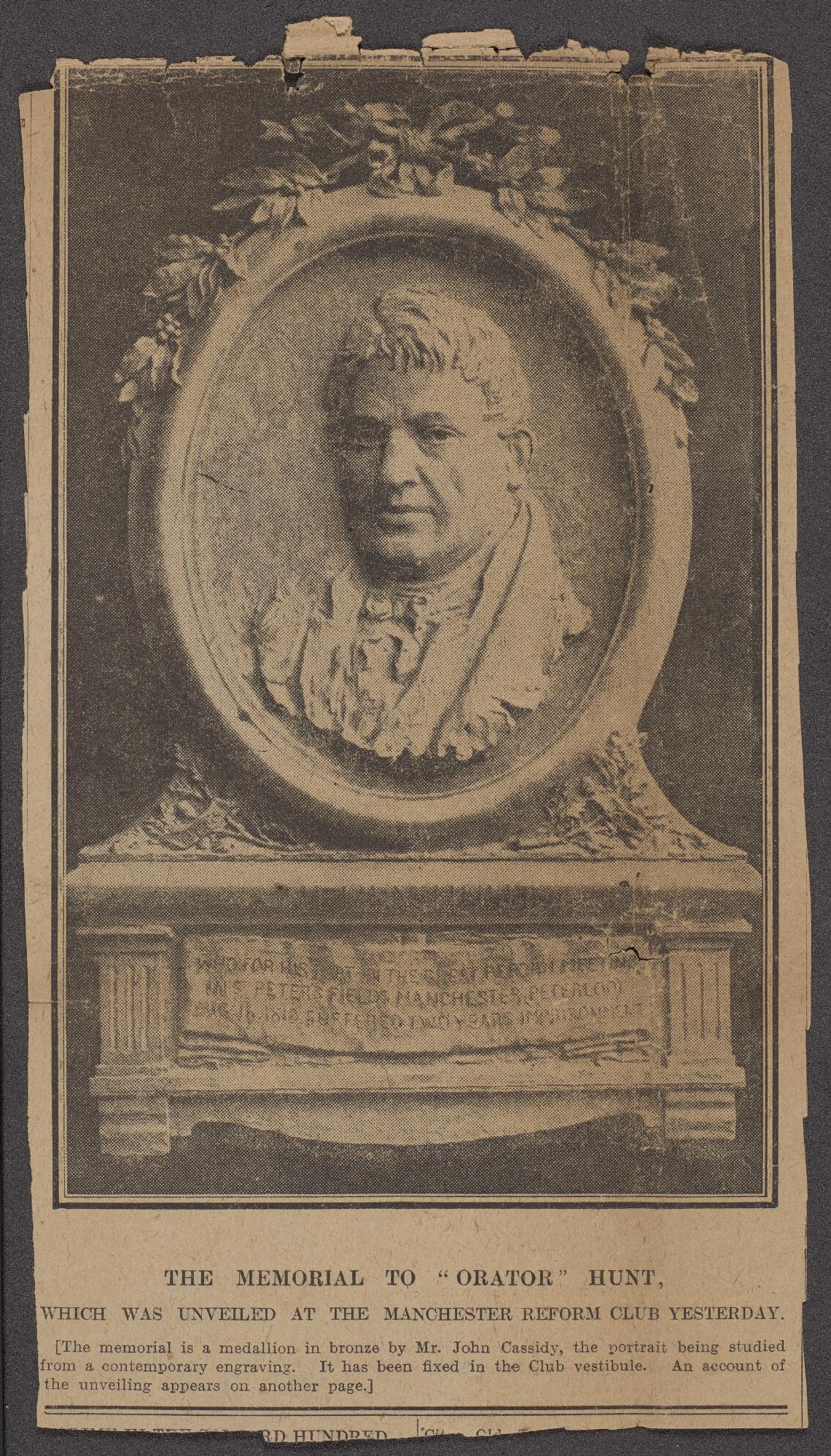
In 1842, a 9-metre-tall monument to the memory of Hunt and the Peterloo victims was erected in Ancoats. It was dismantled in 1888 when it became unsafe. That same year, a group was set up to re-erect the monument or to create a new permanent memorial. This must have proved impossible, since most of the money collected through subscriptions was spent 20 years later on a 114 × 77 cm bronze medallion created by the artist John Cassidy. This medallion was unveiled by C. P. Scott, editor and owner of the Manchester Guardian, on 29 June 1908 at the Manchester Reform Club on King Street, where it hung until 1987.

At that same ceremony and as part of the donation, a set of prints of Peterloo and a collection of pamphlets, newspaper cuttings and books were presented to the Manchester Reform Club. It seems highly likely that those pamphlets and newspaper cuttings constitute our Peterloo scrapbook. This is supported by a presentation label on the front pastedown, which records the Manchester Reform Club as the recipient of the scrapbook and the Henry Hunt Memorial Committee, with C. P. Scott as chairman, as the donor. It also records the date of the donation, “June 29th, 1908”.

Provenance of individual items
Most individual items in the scrapbook do not carry clear signs of provenance. There are two specific exceptions.
The first is a set of two broadsides and a leaflet with remnants of wax seals, postal stamps and handwritten addresses. All appear to have been sent to Edward Bootle-Wilbraham, a Conservative MP for Dover whose permanent residence was Lathom House, Ormskirk, Lancashire. He was a vocal defender in Parliament of the Manchester magistrates and the Manchester and Salford Yeomanry.
The second exception consists of two issues of the Manchester Observer carrying manuscript inscriptions in black ink above the masthead. A copy of the issue published on 20 November 1819 reads:
“Bought at the Observer Office from John Chorlton by John Shawcross 20 Nov. 1819.”

A copy of the issue published on 3 June 1820 reads:
“Bought at the Observer Office from [blank space] by John Shawcross 3 June 1820.”

According to Robert Poole, John Chorlton was a young shop assistant at the Observer Office who, under threat of prosecution, shared information with a man who corresponded with the Manchester magistrates under the codename “M”. John Shawcross seems to have been a police clerk who might have contributed to gathering information about subversive reformist activities. Is it possible that John Shawcross is the enigmatic “M”?
What is clear is that his cooperation did not gain Chorlton much leniency. When the authorities cracked down on the Manchester Observer, he was tried at the Salford Quarter Sessions in January 1820 and sentenced to four months imprisonment for selling the issue of 28 August, which contained an advertisement for the first issue of Peter-Loo Massacre, in which the troops are called murderers. Peter-Loo Massacre was a series of pamphlets published by James Wroe, publisher of the Manchester Observer and one of the organisers of the 16 August 1819 meeting. We can only speculate, but the absence of John Chorlton as a familiar figure behind the counter might have resulted in a blank space where the name of the shop assistant should have been recorded above the masthead of the copy of the issue published on 3 June 1820 included in the scrapbook.

A newer acquisition: a bound-with of radical reform publications (R191471)
A few months after cataloguing the scrapbook, the University of Manchester acquired a volume containing several different radical reform publications bound together. Many of these predate the Peterloo Massacre, while some reflect on it as a contemporary, era-defining event. Most crucially, this volume includes the complete run of Peter-Loo Massacre in book form (5th edition): the 14 pamphlets comprising the complete run of this publication were originally issued with continuous pagination and, immediately after the series was completed, published as a book, with a portrait of Henry Hunt as a frontispiece, a preface and a folding map between pages 76 and 77. The portrait and map are missing from the copy included in this volume. The full title of the work as it appears on the title page gives us a good idea of Wroe’s determination to seek justice for the victims in spite of the possibility of retaliation from the authorities: Peterloo massacre, containing a faithful narrative of the events which preceded, accompanied, and followed the fatal Sixteenth of August, 1819, on the area near St. Peter’s Church, Manchester, including the proceedings which took place at the inquest at Oldham, on the body of John Lees, who died in consequence of wounds and bruises received at the above time and place. To which is added, an accurate alphabetical list of the names and places of residence of those who were killed, wounded and maimed, by the sabre or otherwise, with an account of the nature of the injuries sustained.

The two items here presented are very valuable additions to the extensive collection of Peterloo materials held by the University of Manchester and will contribute greatly to scholarship on the subject.
More to read:
Martin, Janette:
- Documenting Peterloo: the digitisation of a rediscovered bound volume of Peterloo ephemera (Janette Martin’s Medium blog, 11 August 2026)
- Peterloo Legacies: Rare Peterloo pamphlet and poetry books donated to The John Rylands Library (Rylands blog, 10 November 2019)
- A Closer Look at the Manchester Observer (1819–1822) (Rylands blog, 9 April 2019)
- Opening up the Peterloo Collections at the University of Manchester Library (Rylands blog, 7 February 2019)
- Isabella Banks, ‘Orator’ Hunt and the Peterloo Massacre (Rylands blog, 7 December 2018)
- Peterloo: The Forgotten Massacre? (Rylands blog, 25 September 2018)
The National Archives:
People’s History Museum:
Poole, Robert:
- The Manchester Guardian and the Manchester Observer (Rylands blog, 16 August 2021)
- The Manchester Observer: biography of a radical newspaper (Bulletin of the John Rylands Library, Spring 2019)
Science Museum Group:
The University of Manchester – Manchester Digital Collections
Websites
0 comments on “A Peterloo Scrapbook”